
UAE GCAA Overflight & Landing Permits: Operator Guide
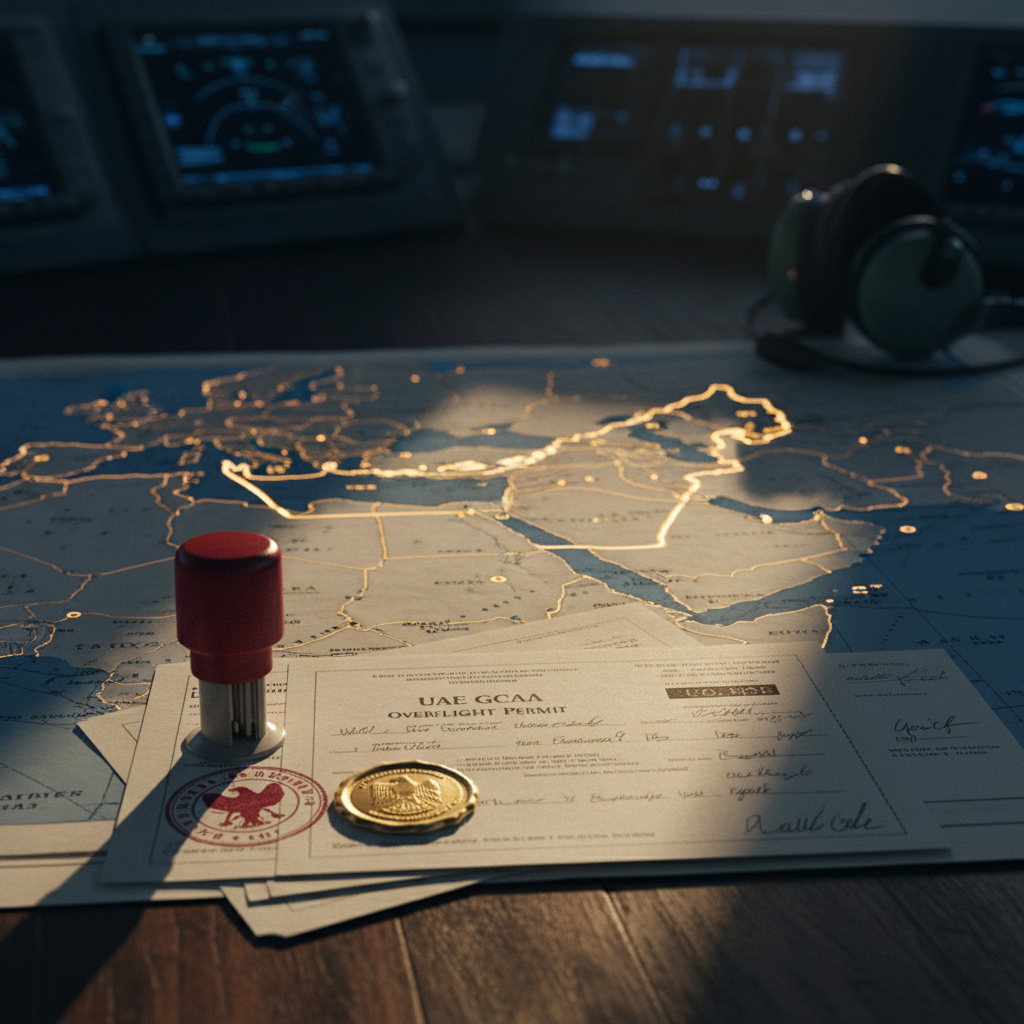
Practical, current operator guide to GCAA overflight and landing permits for UAE operations — what to file, when, and why applications get rejected.
Practical, current operator guide to GCAA overflight and landing permits for UAE operations — what to file, when, and why applications get rejected.
Why GCAA permits matter
The UAE General Civil Aviation Authority (GCAA) issues overflight and landing permits for the Emirates FIR and all UAE civil airports including OMDB (Dubai International), OMDW (Dubai World Central), OMAA (Abu Dhabi), and OMSJ (Sharjah). For most Western-registered business jet operators, the UAE is the single most-visited destination in the region, which means GCAA processes are core operational knowledge — not edge-case work.
Lead times
Standard overflight permits clear in 24–48 hours. Landing permits for non-scheduled commercial operators run 48–72 hours. State, diplomatic, and medevac permits can be expedited inside 4 hours through proper channels. Private/non-commercial movements (Part 91 equivalent) often clear faster than commercial charter. LFS files via the GCAA online portal and maintains direct contact for urgent escalation.
Documents required
For commercial operators: AOC, worldwide insurance certificate, noise certificate, airworthiness certificate, and a complete schedule with passenger/cargo details. For non-commercial: certificate of registration, insurance certificate, noise certificate, airworthiness certificate. All documents must be valid at the time of flight, not just at time of application — a frequent rejection driver is documents that expire mid-itinerary.
Common rejection reasons
The most frequent: insurance coverage below GCAA minimums (USD 150M war-risk for commercial), AOC scope not authorising the proposed operation type, mismatched aircraft details between application and flight plan, and itineraries with Israeli touchpoints filed under operators without the appropriate permissions. The Israeli routing question has eased post-Abraham Accords but is still not automatic — confirm before filing.
Handling at OMDB, OMDW, OMAA
Each field has distinct handler and FBO landscapes. OMDB is dnata-led with Jet Aviation and Skyline supporting executive movements; OMDW is dominated by Jetex and ExecuJet with significantly easier parking and slot access for business aviation; OMAA is split across Royal Jet, Abu Dhabi Aviation, and the Etihad-controlled handling stack. Our Dubai handler comparison breaks down which handler suits which mission profile.
Slot constraints
OMDB applies slot coordination through ADCC; OMDW and OMAA are less constrained but tighten during major events (Dubai Airshow, Formula 1 Abu Dhabi, COP-style gatherings). Plan slot applications in parallel with permit applications, not sequentially.
Related LFS resources
Talk to LFS
LFS Aviation runs 24/7 dispatch from Bahrain. If you have a movement that touches any of the above, send us a trip request or contact our duty desk. We respond inside one hour.
Operator FAQs
How long does a GCAA overflight permit take?
24–48 hours standard. Landing permits run 48–72 hours for commercial operators. Medevac and state movements can be expedited inside 4 hours through proper channels.
What insurance does GCAA require?
Commercial operators need USD 150M minimum war-risk and liability cover. Non-commercial requirements are lower but always check current GCAA bulletins — limits move.
Do we need a separate permit for OMDW vs OMDB?
Yes — each landing requires its own permit tied to that specific airport. Overflight permits cover the Emirates FIR as a whole.
Are Israeli-touching itineraries permitted?
Generally yes since the Abraham Accords, but not automatic. Confirm operator-specific permissions with GCAA before filing the routing.
LFS handles launch-batch-2026-05 24/7.
Send the trip — we acknowledge in under 60 minutes during working hours, immediately for AOG.