
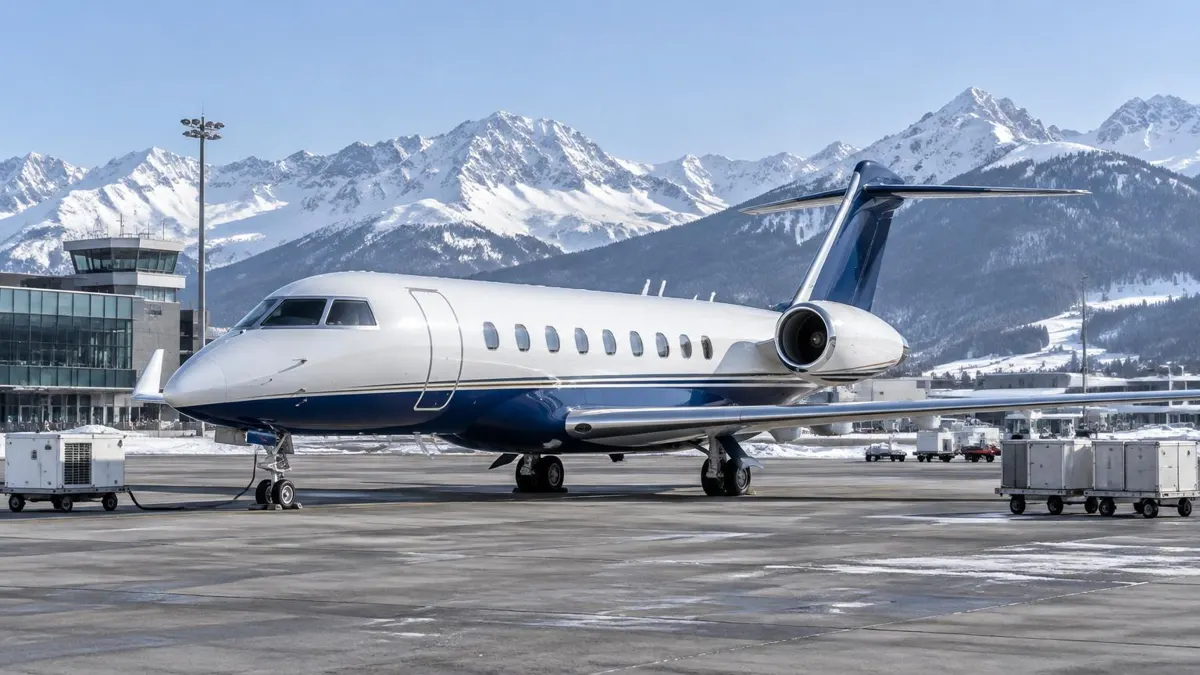
Representative aviation illustration; not a photograph of event operations, LFS facilities or personnel.
Annual Meeting dates and the complete Davos journey
The World Economic Forum’s official upcoming-events listing identifies the Annual Meeting 2027 for 18–22 January in Davos-Klosters, Switzerland. Use the latest organiser information for the passenger programme and treat aviation approvals as a separate planning stream. Delegate accreditation or a hotel confirmation does not authorise an aircraft movement, establish a parking stand or guarantee a road or helicopter connection to the meeting.
Corporate visitors may have appointments outside the formal meeting dates, so request the aircraft schedule that reflects the actual programme. The arrival airport and the overnight aircraft location may be different. LFS does not claim to be a World Economic Forum partner, provide meeting accreditation or offer priority event access. This is an independent flight-support enquiry service for operators who need a practical winter trip plan.
Compare Zurich and regional options against operating suitability
Zurich (LSZH / ZRH) is an airport option to assess for an international arrival and onward ground transfer. St Gallen-Altenrhein (LSZR / ACH) and Samedan/Engadin (LSZS / SMV) require a separate review of aircraft suitability, current procedures, provider acceptance and passenger logistics. Proximity to Davos alone is not a reason to select an airport. The operator must assess performance, terrain, weather and the available arrival and departure procedures.
Samedan’s published familiarisation material describes a mountainous operating environment and specific pilot qualification requirements. Do not transfer a generic business-jet arrival assumption to LSZS. Obtain the current airport briefing and verify qualification and currency for the actual crew. A different airport may offer a more suitable operational plan even if it lengthens the ground journey; explain that trade-off before a passenger commitment makes the nearer field appear mandatory.
WEF airspace restrictions: use 2027 publications, not last year’s briefing
Previous WEF meetings have involved special airspace and PPR arrangements, but this page does not reproduce the 2026 restriction dimensions, frequencies or validity windows as 2027 rules. The operator must consult the current Swiss AIP, event-related supplements, NOTAMs and airport instructions when released. A previous year’s familiar trip is useful experience, not authority to enter a new restricted area or file the same procedure again.
Ask the flight-support desk to identify which current permissions, slots or PPR references apply to the selected movement and who issues them. Keep airport acceptance, airspace authorisation and aircraft handling separate in the trip summary. A road transfer booking or delegate invitation cannot replace aviation requirements. If the passenger programme changes the intended airport or arrival window, check whether the relevant permissions remain valid before dispatch.
Winter dispatch, alternates and de-icing coordination
January operations require a flight-department assessment of weather, runway condition, terrain and aircraft performance. A handling request should specify likely de-icing needs, ground-power requirements and the operator’s departure priorities, but service availability and timing must be confirmed by the accepted provider. LFS does not promise all-weather accessibility, an assured de-icing queue position or a dispatch decision on behalf of the operating company.
Prepare an alternate strategy that includes passenger recovery, not only an alternate airport in the flight plan. If weather prevents the preferred arrival, identify how passengers can reach their destination, where the aircraft can park and what happens to the return itinerary. Mountain conditions and road weather can affect separate parts of the journey simultaneously. The crew needs a plan that remains legally and operationally acceptable, not pressure to use a particular airport because a transfer was prepaid.
Parking, ground services and a workable departure window
Request parking for the complete aircraft stay and ask whether stand changes, towing or repositioning are part of acceptance. A delegate remaining in Davos for several days does not imply the aircraft can remain at its arrival airport for the same period. Review any repositioning leg for permits, crew duty, fuel and additional handling. If a handler offers a stand subject to later release, make that condition visible in the operator’s decision file.
Fuel, catering, baggage handling and departure preparation should be coordinated at the aircraft’s confirmed location. State the required fuel quantity and billing arrangement, and ask for any winter servicing constraints relevant to the accepted stand. Passenger departure plans may change rapidly as meetings conclude. Confirm the aircraft’s feasible movement window before promising a collection time, especially where airport capacity and winter preparation both affect the departure sequence.
Ground transfers, helicopter enquiries and delegation security
Provide the exact Davos destination, passenger count, luggage quantity and any accessibility needs when requesting a road transfer. Travel time should be checked for the selected route and actual winter conditions; no fixed airport-to-Davos journey time is promised here. Ask where the driver meets the passengers, how delays are communicated and whether the vehicle arrangement covers a changed arrival airport. A revised flight should trigger a transport review as well as a handler update.
If a helicopter connection is requested, treat it as a separate aviation operation with its own provider acceptance, landing permissions, weather limits and passenger requirements. It is not a guaranteed alternative to a road journey or a means to bypass airspace restrictions. For official or security-sensitive delegations, explain the relevant operational needs through the approved enquiry process without assuming diplomatic treatment. LFS does not issue security credentials, immigration permissions or meeting access.
What LFS coordinates and what remains with the operator
LFS reviews the requested itinerary and coordinates flight planning, permit enquiries, airport handling, fuel arrangements and crew logistics with the relevant parties. The operating company retains operational control, dispatch responsibility and the final go/no-go decision. Airports allocate capacity, authorities issue permissions and licensed providers deliver the services they accept. Event attendance is not an operating authorisation, and an enquiry is not a confirmed booking.
Ask for a written trip summary identifying confirmed services, pending applications, outstanding documents and commercial conditions. Keep the current version available to the flight department and crew, especially when passenger plans change independently of the aircraft schedule. LFS is an independent flight-support coordinator, not an official event organiser, ticket agent or event-appointed aviation provider. No affiliation with the event or guaranteed access is implied.
Send a complete flight-support enquiry
Aircraft, schedule and service requirements
Use the existing LFS flight-support request form. Include the operator name, aircraft registration and type, route, arrival and departure dates, UTC times, passenger and crew numbers, and the purpose of the movement. Identify every sector, including positioning flights, and distinguish a firm schedule from a provisional option. For unusual aircraft, give dimensions and handling requirements rather than relying on the model name alone.
Select the required services for each leg: permits, flight dispatch, ground handling, fuel, slots and parking, crew accommodation, passenger transport or catering. Add any special constraints in the remarks, such as restricted ground access, equipment shipments, a minimum departure fuel quantity or a non-negotiable passenger collection time. Do not place sensitive passport information in general enquiries unless it is needed and requested through the approved process.
Confirm scope before committing the aircraft
A useful response should distinguish an indicative quotation from a confirmed airport acceptance. Ask which items depend on external approval, what documents remain outstanding, how schedule changes are handled and which cancellation or overtime charges apply. Check that fuel, parking, repositioning and ground transfers cover the same itinerary. Keep authority permissions, airport acceptance and handler confirmation as separate references; none automatically substitutes for another.
When you revise the trip, quote the existing LFS trip reference and list the affected sectors. A changed registration, arrival airport, departure time or passenger purpose may require more than a simple remark on the original request. The operations desk can review the consequences, but the aircraft should not depart on an assumption that pending services will be accepted after arrival.
Frequently asked operational questions
When is the World Economic Forum Annual Meeting 2027?
The Forum’s official upcoming-events listing gives 18–22 January 2027 in Davos-Klosters. Recheck the current organiser programme before finalising passenger commitments.
Which airport is best for a Davos trip?
There is no universal answer. Assess Zurich LSZH/ZRH and any regional option against the aircraft, crew qualifications, weather, accepted capacity and onward transfer requirements.
Can any business-jet crew operate to Samedan?
Do not assume that. Engadin Airport publishes familiarisation and qualification requirements for its mountainous environment; the operator must verify the current rules and crew currency.
Do the 2026 WEF airspace rules apply in 2027?
They must not be reused as current authority. Obtain the relevant 2027 Swiss AIP supplements, NOTAMs, airport instructions and any required permission references.
Does a delegate badge guarantee airport or aircraft access?
No. Meeting accreditation, passenger entry, airport security access and aircraft permissions are separate. The responsible organiser, authority or provider decides each requirement.
Can LFS guarantee a helicopter transfer to Davos?
No. A helicopter enquiry is subject to provider acceptance, weather, operating permissions and landing arrangements. Keep a realistic ground-transfer fallback.
What winter details should we include in the request?
Provide the aircraft, route and UTC schedule, parking duration, crew plan, fuel and likely de-icing needs, passenger destination and any alternate or transfer constraints.
Event and operational references
Reviewed 11 November 2026. Organiser schedules may change. Current AIPs, NOTAMs, authority decisions and written airport and provider acceptance govern the flight.
Send your event flight requirements
Provide your operator, aircraft, route, UTC schedule and required services through the existing LFS enquiry process. Include the event name and distinguish confirmed sectors from provisional plans.
Request Flight Support