
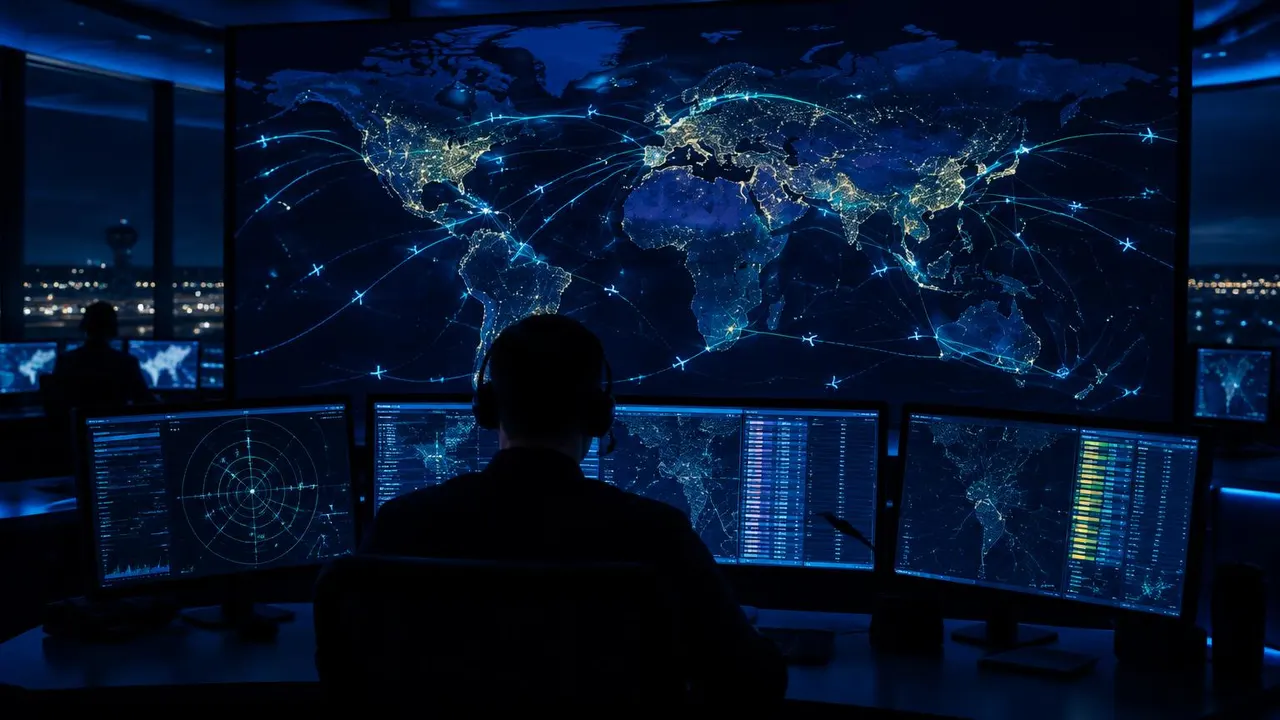
What flight watch actually does
Flight watch is the disciplined following of a flight from first engine start to final shutdown. It is not a tracking map on a screen — it is a person comparing what the aircraft is doing against what was planned, noticing the difference early, and acting on it. A departure twenty minutes late is not a problem; a departure twenty minutes late that nobody tells the destination handler about is.
The LFS desk monitors each movement it supports: off-block and airborne times, en-route progress against the flight plan, estimated arrival, and on-block confirmation. The information comes from ATC movement messages, tracking feeds and direct contact with crew and handlers. When reality diverges from the plan, the desk works the consequences: the handler's meeting time, the fuel slot, the crew's duty window, the passenger's car at the other end.
Why business aviation needs active monitoring
Airlines have operations centres watching every tail. A business jet operator with two aircraft and a part-time dispatcher does not — yet the same aircraft still crosses multiple FIRs, lands at airports with curfews and slots, and carries principals whose schedules tolerate no surprises. The gap between having a flight plan and having someone watching the flight is where most avoidable disruption lives.
A monitored flight gets its problems solved while they are small. A delayed departure triggers a handler and slot revision before the aircraft is even airborne. An en-route diversion is met by a prepared airport rather than a surprised one. An arrival running early gets its car and handler pulled forward. None of this happens automatically; it happens because someone is watching and has the authority and contact list to act.
Movement messages, tracking feeds and human judgement
The desk works from the same movement messages ATC uses — departure, arrival and delay messages — supplemented by position tracking and direct reports. Each source has blind spots: tracking coverage drops over oceans and remote regions, movement messages depend on the local ATS unit, and a position on a map says nothing about why the aircraft is holding. Flight watch is the layer that reconciles these sources into one coherent picture.
Judgement matters most when the data conflicts. An aircraft that disappears from tracking over the North Atlantic is usually fine; the same disappearance on a short European sector is worth a phone call. An arrival message that never arrives needs chasing, not assuming. The desk escalates to the operator when something needs their decision and handles everything else directly — the goal is that the operator hears about problems with a proposed solution attached, not as raw alerts.
Keeping ground arrangements synchronised with the aircraft
Every movement has a chain of dependent services: the handler meeting the aircraft, the fuel uplift, catering delivery, crew transport, passenger cars, and the slot or parking window at the next airport. When the aircraft's schedule changes, every link in that chain has to be re-confirmed — and a message sent is not a confirmation received. The desk tracks acknowledgements so nothing is assumed.
This is where flight watch connects to the rest of trip support. Because the same desk coordinates handling, fuel and permits, a schedule change is propagated internally rather than across a chain of separate suppliers. The operator gets one point of contact who already knows the whole trip, instead of re-explaining the change to five different providers.
Flight watch for charter brokers and aircraft managers
Brokers and aircraft managers carry a particular burden: they are answerable for flights they do not operate. A broker whose client asks 'where is my aircraft?' needs an answer in seconds, and a manager reporting to an owner needs a record of every movement and every irregularity. Flight watch gives both a single source of truth for the trips they have sold or managed.
The desk provides movement updates in the format the customer actually uses — a message on each leg, a summary at the end of the day, or immediate notification only when something changes. For managed fleets, the flight watch log becomes part of the trip record: what was planned, what happened, and what was done about it. That record matters for service quality reviews and for answering the owner's questions months later.
Setting up flight watch for your operation
Flight watch is available as part of any trip LFS supports, and as a standing arrangement for operators who want every movement monitored whether or not the desk planned the trip. Standing cover suits operators with regular flying who want a 24/7 watched operation without staffing their own round-the-clock desk.
To scope it, send your aircraft, typical routes and monthly movement volume through the request form. The desk will propose a monitoring setup — what is watched, how updates reach you, and how irregularities are escalated — matched to how your operation actually works. For operators who need fuller dispatch cover beyond monitoring, see outsourced flight dispatch.
Overnight, weekend and holiday cover
Most business aviation disruption happens outside office hours, because that is when the aircraft flies. A Friday evening departure that slips into Saturday morning crosses the exact hours when an in-house flight department is hardest to staff. The LFS desk operates 24/7/365 as a matter of structure, not as an on-call arrangement — the person watching your flight at 03:00 is on shift, not asleep with a phone on the nightstand.
This matters most for the unglamorous middle of a trip: the aircraft that departed on time and is simply crossing the night. If nothing happens, the log shows a quiet, confirmed flight. If something does happen — a hold, a diversion, an unplanned tech stop — the response starts immediately rather than when someone checks their messages in the morning. The difference between those two outcomes is the entire point of the service.
What flight watch does not do
Flight watch is not operational control. The desk does not release flights, make weather decisions or direct the crew — those responsibilities stay with the operator and the pilot in command, exactly as the regulations place them. What the desk provides is awareness and coordination: the earliest possible notice that reality has moved away from the plan, and the ground-side work to catch up with it.
It is also not a substitute for the operator's own safety systems. A monitored flight still needs the operator's dispatch release process, fatigue management and maintenance control working as they should. Flight watch sits alongside those systems as an additional pair of eyes with a long contact list, and it is most effective when the escalation paths between the desk and the operator's decision-makers are agreed before the first flight is watched.
The flight watch record as an operational asset
Every watched flight produces a record: planned versus actual times, the variances noticed, the actions taken and the confirmations received. For a single trip this is simply good practice. Across a season of flying it becomes something more valuable — evidence of how the operation actually performs, which routes and airports generate the most disruption, and where the schedule's assumptions diverge from reality.
Operators use these records in different ways. Flight departments feed them into service reviews with owners and principals. Charter operators use them to quote more realistic schedules on routes they fly repeatedly. Aircraft managers include them in owner reporting as a factual account of the aircraft's use. The record is only useful because it is kept by someone whose job is to watch — reconstructed after the fact, the same information is unreliable.
Operational planning questions
Is flight watch the same as flight tracking?
No. Tracking shows where an aircraft is. Flight watch is a person comparing the aircraft's actual progress against the plan, spotting differences early and acting on the consequences — handlers, fuel, slots, crew and passenger arrangements.
Can LFS watch flights it did not plan?
Yes. Standing flight watch covers movements planned by your own team or another provider. The desk needs the schedule, aircraft details and your escalation preferences in advance.
How are problems escalated?
Agreed with you in advance. Routine variances are handled directly by the desk; anything needing an operator decision — a diversion option, a crew duty issue, a significant delay — is escalated immediately with a proposed course of action.
What information does the desk need per flight?
Aircraft registration and type, route, UTC schedule, handling and fuel arrangements at each stop, crew contacts, and your preferred update channel. For trips LFS planned, all of this is already on file.
Does flight watch replace the operator's responsibilities?
No. Operational control and all safety decisions remain with the operator and crew. Flight watch is a monitoring and coordination service — it keeps information and ground arrangements aligned with the real movement.
Operational references
Reviewed 23 October 2026. Current AIPs, NOTAMs, authority decisions and written provider acceptance govern the actual flight.
Send your operational requirements
Provide your route, aircraft details, UTC schedule and required services. LFS will review the request and confirm the proposed coordination scope, documentation and commercial terms. Acceptance remains with the relevant authority, airport and service provider.
Request a Quote