
Hajj & Umrah Charter Operations: Jeddah and Madinah
LFS provides trip support for these flights. Charter, ACMI/leasing, aircraft sales and management are handled by our sister brand MEGA.
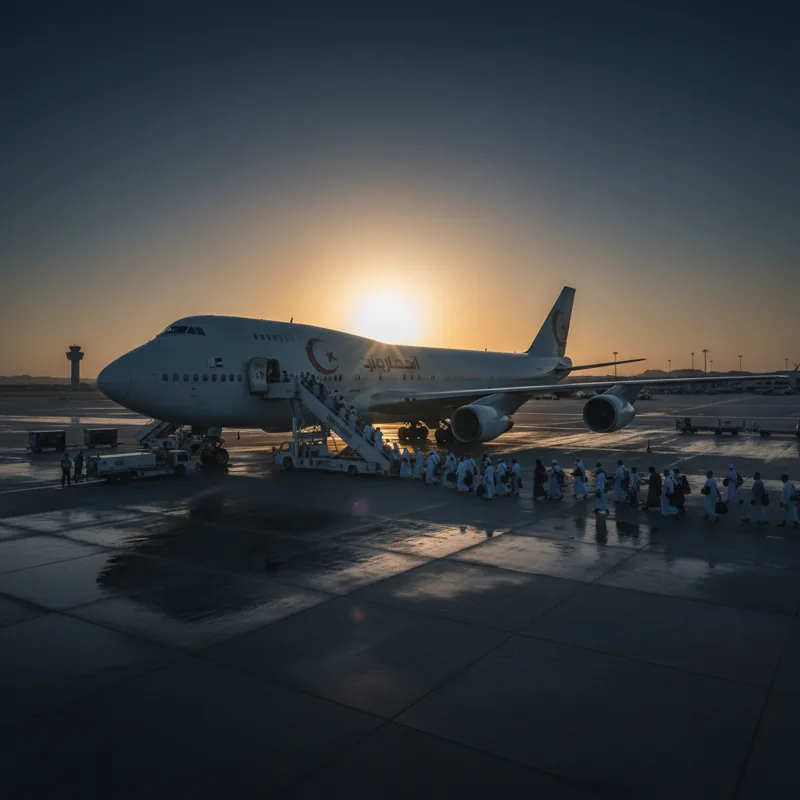
How LFS plans Hajj and Umrah charter movements into OEJN and OEMA — including the slot lottery, parking constraints, and what 'peak week' actually looks like on the ground.
How LFS plans Hajj and Umrah charter movements into OEJN and OEMA — including the slot lottery, parking constraints, and what 'peak week' actually looks like on the ground.
The annual operational picture
Hajj season concentrates roughly 1.8 million pilgrims into Saudi Arabia across a four-week window, with the bulk of arrivals into OEJN (Jeddah King Abdulaziz) and OEMA (Madinah Prince Mohammad). Umrah, in contrast, runs year-round but peaks during Ramadan and the last ten days of the month. Both seasons drive extreme charter demand from operators in Indonesia, Malaysia, Türkiye, Pakistan, Egypt, Nigeria, and the Maghreb. From an operational standpoint, the consequence is that every standard slot, parking position, and handler resource is under pressure for weeks at a time.
Slot allocation
OEJN and OEMA both operate under Hajj-specific slot coordination through GACA (General Authority of Civil Aviation). Charter operators apply through their national civil aviation authority, which forwards to GACA on a coordinated basis. Slot windows are typically published 60–90 days before the season opens. Late applications are not impossible to clear but cost significant time. LFS works with operators on Hajj filings beginning four months out wherever possible.
Ground handling realities
Saudi Ground Services (SGS) handles the bulk of Hajj charter traffic at OEJN, with dnata and SAS handling specific airline contracts. Turn times that would run 45 minutes in a normal week routinely stretch to 90–120 minutes in Hajj week purely because of pilgrim processing, Zamzam water loading, and baggage volumes. Build that into the rotation plan rather than assume baseline.
Fuel posture
Jet A-1 supply at both fields is reliable but uplift queues lengthen sharply. Pre-coordination with Aramco / SATORP through the handler is essential. LFS confirms uplifts 24 hours pre-arrival and again at TOC. Pricing follows Saudi domestic posts, which we cover in our Gulf jet fuel pricing explainer.
Crew and duty planning
Hajj charters frequently run as 2-pilot operations on tight back-to-back rotations. Crew rest in Jeddah is workable but hotel inventory tightens. We typically position augmented crews and use Bahrain (OBBI) as the off-rotation rest base — covered in our Bahrain trip support hub article — because OBBI parking, customs, and crew transit are materially easier than Jeddah during peak.
Documentation and pilgrim manifests
Hajj and Umrah passengers travel on Hajj-specific visas and must appear on manifests in the format GACA prescribes (Arabic and Latin spelling, passport number, visa number, group leader code). Manifest rejections cause the most common departure delays. LFS dispatch validates the manifest against GACA format before filing the flight plan.
Related LFS resources
- Charter & VIP operations
- Saudi overflight permits
- Bahrain trip support hub
- Request charter support
Talk to LFS
LFS Aviation runs 24/7 dispatch from Bahrain. If you have a movement that touches any of the above, send us a trip request or contact our duty desk. We respond inside one hour.
Plan the season, not just one arrival
Hajj charter flights require an airline-level programme as well as individual movement preparation. Start with the operator, intended airports, inbound and outbound date ranges, proposed frequencies, aircraft types and passenger programme. The return schedule deserves the same attention as the arrival: crew planning, aircraft positioning and ground arrangements must work across the complete operation. Provisional schedules should be identified as provisional so that a quotation is not mistaken for an accepted operating programme.
GACA publishes season-specific Hajj instructions covering carriers and their agents, scheduling, slots and operational obligations. An earlier edition is useful background but is not proof of the current season's operating window or document requirements. LFS checks the applicable current instructions and the operator's authorization status before coordinating the programme. Do not copy a previous year's approval dates or assume that an existing airline authorization resolves every seasonal requirement.
Separate operator authorization from seasonal arrangements
GACA lists initial foreign-air-operator authorization for scheduled and unscheduled carriers under GACAR Part 129. That operator-level subject should be reviewed separately from flight clearance, seasonal instructions, schedule acceptance and airport services. The phrase Hajj or Umrah charter is not itself an approval category that removes the need to establish which requirements apply. The carrier remains responsible for its operational compliance and the authority decides acceptance.
Describe whether the programme is a charter series, scheduled service or another permitted activity. Identify any aircraft operated under a different certificate and disclose the arrangement for review. Commercial group commitments should not be treated as evidence that flight permission or airport capacity is secured. Agree who is authorised to confirm changes on behalf of the airline before circulating amended schedules to agents, handlers and suppliers.
Jeddah and Madinah: confirm the actual passenger plan
For Jeddah OEJN, request confirmation of the relevant passenger-processing arrangements for the flight, rather than assuming a named terminal is available to every charter. For Madinah, specify the destination airport and the passenger programme in the original enquiry. Airport acceptance, stand allocation, processing and service delivery remain matters for the airport and appointed providers. This article does not establish terminal access rights or a guaranteed capacity allocation.
Passenger counts, baggage volumes and mobility requirements materially affect the ground brief. Advise the handler of group structure and assistance needs using appropriate, proportionate information. Confirm the arrangements for late passengers, delayed baggage and schedule disruption before the first rotation. Flight support concerns the operational coordination; it should not be confused with organising the pilgrimage itself or issuing passenger travel permissions.
A practical airline programme checklist
Prepare the operator and aircraft documentation requested through the applicable process, a master UTC schedule and a clear aircraft-type list. Include passenger forecasts, ground-service needs and contacts for airline operations, commercial decisions and local passenger coordination. Identify any uncertain rotations and the date by which they will be confirmed. Record how a change in aircraft capacity affects the programme and who approves the revised ground-support scope.
Crew planning should include duty constraints, positioning, accommodation, transport and contingency arrangements. Fuel enquiries need a quantity estimate and the commercial release basis for each airport. Handling enquiries need the aircraft specification, turnaround expectations and passenger or baggage requirements. None of these preparation items guarantees a service; each requested element must be confirmed with the responsible party.
Changes, recovery and commercial scope
A delayed rotation can affect the next aircraft sector, crew duty and the passenger programme. Establish a single operational escalation contact and a method for distributing revised times. Ask LFS to review authority and airport implications before assuming a slot or movement can shift. Keep the approved programme and the working schedule distinct so that unresolved changes are visible rather than silently incorporated.
Request a quotation that distinguishes permit coordination, ground supervision, handling-provider services, fuel, crew logistics and any other agreed work. Ask how cancellations, aircraft substitutions and programme amendments are treated. No current seasonal fee, slot allocation or guaranteed approval time is published here. Those items require a valid current-season and operation-specific confirmation.
Put the enquiry on the existing operational journey
Send the programme through Request trip support, identifying Hajj or Umrah, the airline, aircraft, airports and UTC dates. The existing Saudi Hajj and Umrah permit support page addresses the dedicated enquiry intent. Request fuel and crew support alongside the programme so the final arrangements use the same schedule.
Season-specific reference
GACA's Hajj instructions reviewed for this guide concern 1446 AH / 2025. They demonstrate the seasonal nature of the requirements, not current-season approval. Obtain the applicable edition before relying on dates or conditions.
Operator FAQs
When does Hajj season run in 2026?
Hajj follows the Islamic lunar calendar. In 2026, the core arrivals window runs late May into late June, with departures continuing into early July. Confirm exact dates with GACA closer to the season.
How early should we file for Hajj slots?
Four months out is the LFS recommended lead. Slot allocation publishes 60–90 days before the season but the documentation chain through your national CAA takes time.
Can we operate to Madinah instead of Jeddah?
Yes — OEMA is fully equipped for wide-body Hajj operations and is often less congested than OEJN. Many Southeast Asian and African operators prefer it.
Is Umrah season as constrained as Hajj?
Less so, but the last ten days of Ramadan come close. Treat that window with Hajj-equivalent planning discipline.
Can last season’s Hajj instructions be used as this season’s approval?
No. GACA publishes season-specific instructions. The applicable current edition and your operator and programme acceptance must be checked before operations.
Does a Hajj charter enquiry confirm terminal access?
No. Passenger processing, airport acceptance, stands and services must be confirmed for the actual airport, operator and flight programme.
LFS handles launch-batch-2026-05 24/7.
Send the operator, aircraft, UTC schedule and required services. Flag urgent movements; approvals and service availability require confirmation.