
Jordan overflight permits authorise a civil flight to transit Jordanian airspace on a defined route. Jordan landing permits authorise it to arrive at an airport in the Kingdom for a stated purpose. Civil aviation in Jordan is regulated by the Civil Aviation Regulatory Commission (CARC), which assesses requests on the basis of the operator, aircraft, routing, schedule and flight purpose.
Jordan's airspace links the Arabian Peninsula and Iraq with Egypt, the eastern Mediterranean and Europe, so it often appears on transit routings that never land in the country. At the same time, Amman and Aqaba are destinations in their own right for business, charter and humanitarian traffic. This page covers both cases and explains how LFS supports the request.
Overflight versus landing authorisation in Jordan
Transiting the Amman FIR
For a transit flight, the request rests on the route through the Amman FIR: entry and exit points, airways, and times at the boundaries. Regional airspace conditions can change routings at short notice, so operators should check current NOTAMs and be ready to revise the request if the filed route has to move.
Landing in Amman or Aqaba
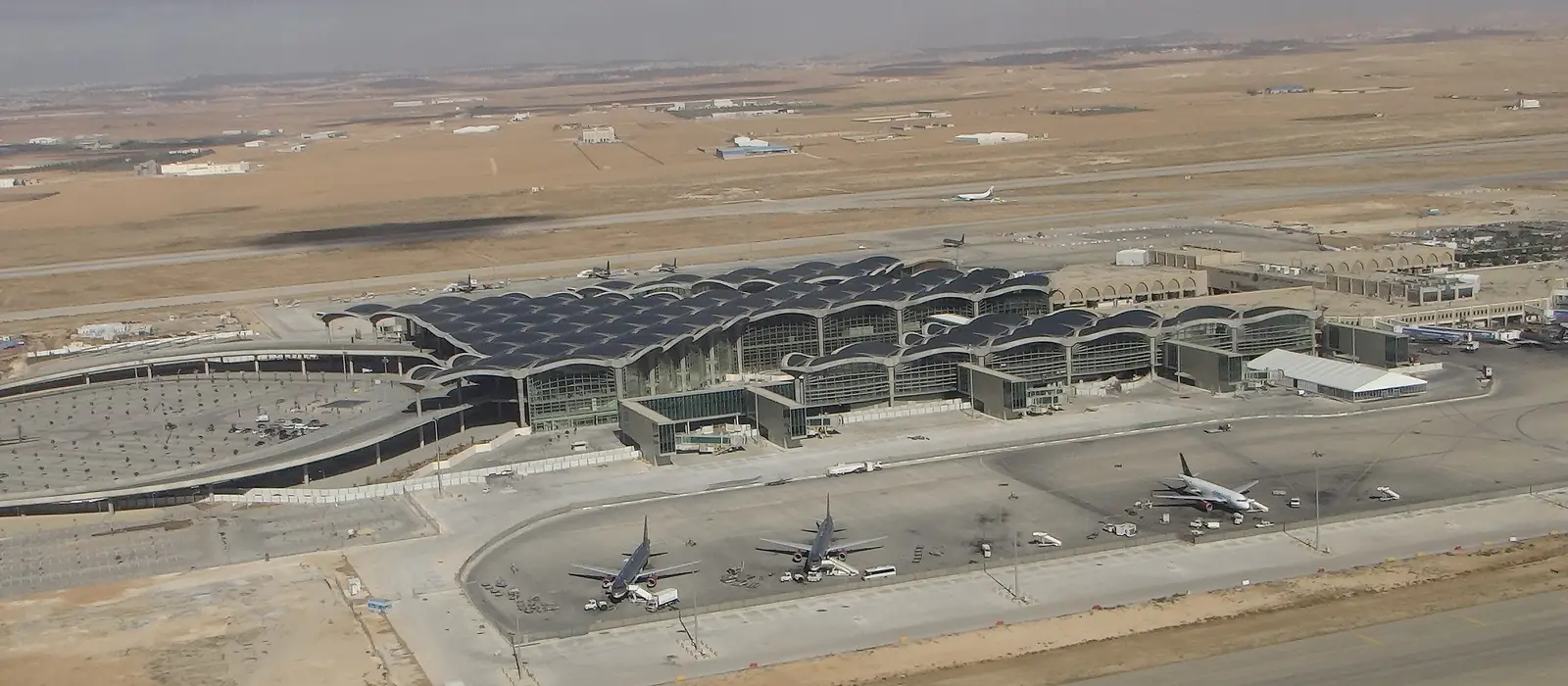
Landing requests add the destination and the purpose of the visit. Jordan has three main civil airports for this kind of traffic: Queen Alia International (OJAI) south of Amman, Amman Civil Airport at Marka (OJAM), and King Hussein International in Aqaba (OJAQ). Which one suits the trip depends on the aircraft, the purpose and the ground services needed. LFS station notes are on the Queen Alia, Amman Marka and Aqaba pages.
Permit planning for aircraft transiting or landing in Jordan
Start with the shape of the trip. A Gulf-to-Europe transit, an Amman round trip and a multi-stop tour of the Levant each create a different set of permits, and Jordan's request should be built with its neighbours in mind. LFS plans the itinerary end to end so the Jordan file uses the same aircraft, operator and timing data as every other country on the route.
If the flight lands, the ground plan needs to be ready alongside the permit: handling, parking, fuel and any passenger facilitation. For those services, see flight support in Jordan.
Operator, aircraft, route, schedule and purpose details
A useful first message to the LFS desk covers:
- The operator, its nationality and whether the flight is private or commercial.
- Aircraft registration, type and maximum take-off weight.
- The routing, with the Amman FIR entry and exit points for a transit.
- Dates and UTC times for each sector touching Jordan.
- The purpose of the visit, the destination airport and the number of passengers and crew, or details of cargo.
Documentation and coordination considerations
Authorities commonly request the aircraft's certificate of registration, certificate of airworthiness and insurance, and the operator's AOC for commercial flights; crew and passenger details may be asked for on landings. LFS confirms the specific Jordan requirements for each flight against current CARC guidance rather than publishing a fixed list, because what applies depends on the type of operation.
Consistency matters as much as completeness. The registration, operator name and schedule should be identical on every document and on the flight plan. When timings change, the permit may need revising before departure.
Charter, cargo, humanitarian and other operating categories
Different categories of flight can draw different questions. A private flight, a passenger charter, a cargo flight and a humanitarian or aeromedical mission are assessed on their own facts, and an operator should not assume a private-flight process covers commercial traffic. Where CARC publishes category-specific guidance, LFS follows it; where it does not cover the case, we ask before filing.
Aqaba is often used for trips linked to the Red Sea region, while Amman serves most capital-city visits. Either way, the purpose of flight stated in the permit should match what the aircraft actually does on the ground. State and diplomatic flights normally follow government channels; see diplomatic clearance.
Why accurate information and coordination pay off
A permit request that has to be queried is a request that waits. Most queries come from mismatched details, missing documents or a purpose of flight that is unclear. Sorting those out before submission is the single most effective way to avoid delay.
LFS does not publish a standard Jordan processing time or fee because neither is fixed across flight types. Send the request as early as the trip allows, and if you are already inside a short window, read how we handle urgent flight permits.
How LFS supports Jordan flight permits
LFS works from a 24/7 operations desk in Bahrain. We are a flight-support provider, not an authority, and we do not guarantee approval or turnaround. Our role is to:
- Assess the trip and identify the Jordan authorisations that appear to apply.
- Check documents for consistency and validity across the whole trip.
- Prepare and submit the request, and follow it up until a decision is received.
- Revise the permit when the route or schedule changes.
- Coordinate neighbouring overflight permits, flight dispatch and Middle East flight support.
Inquiry checklist for operators
The more of this you can share in the first message, the faster the request can be assessed:
- 01Operator legal name, nationality and operating contact.
- 02Aircraft registration, type, MTOW and call sign.
- 03Transit only, or landing (Queen Alia, Amman Marka or Aqaba).
- 04Routing with Amman FIR entry and exit points.
- 05UTC dates and times for every sector, including the legs either side of Jordan.
- 06Purpose of flight and whether it is commercial.
- 07Crew and passenger numbers, or cargo details.
- 08Ground services needed on arrival.
Frequently asked questions
Who regulates flight permits in Jordan?
Civil aviation in Jordan is regulated by the Civil Aviation Regulatory Commission (CARC). LFS prepares and coordinates the request; the authority makes the decision.
Do transit flights over Jordan need a permit?
Many non-scheduled flights do, but it depends on the operator, the aircraft and the type of flight. Send the details and we will confirm what applies.
Which Jordanian airport should I use?
It depends on the purpose and the aircraft. Queen Alia (OJAI) is the main international airport, Amman Marka (OJAM) is close to the city, and Aqaba (OJAQ) serves the south. We discuss the options when we review the trip.
How long does a Jordan permit take?
LFS does not quote a fixed timeline because it depends on the flight category and the file. Send the request as early as possible and we will confirm a realistic plan.
Can LFS guarantee a Jordan permit?
No. Approval rests with the authority. LFS makes sure the request is complete and consistent so it can be assessed without avoidable queries.
Official sources
Requirements change. Always confirm current rules with the authority or the published AIP before operating.
Related LFS pages
- Flight support in Jordan — handling, fuel and crew logistics
- Queen Alia International (OJAI) station page — airport coordination notes
- Landing permits — how LFS handles landing requests
- Technical stop support — fuel and crew stops on long routes
- All permit services — overflight, landing, diplomatic and slot requests
Ready to Plan Your Jordan Flight?
Submit your route, aircraft details, and flight schedule through our request form. Our dispatch team will review your requirements and confirm the necessary documentation. All permits remain subject to approval by the relevant authority.