
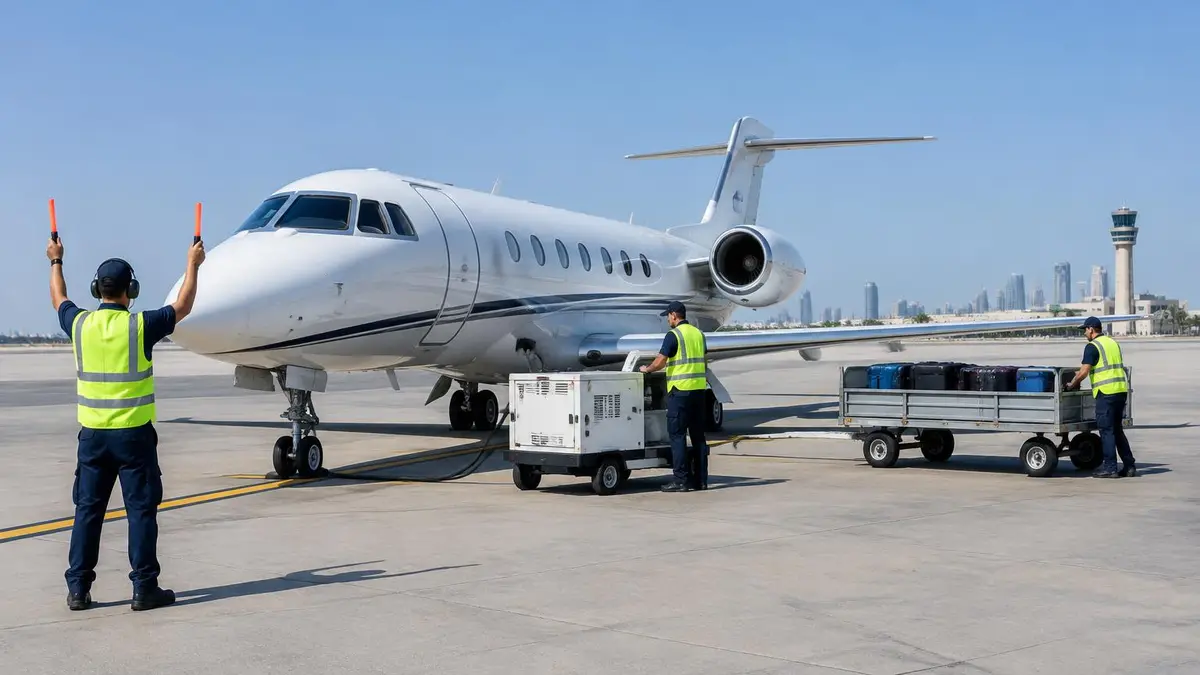
Representative aviation illustration; not a photograph of a specific airport, LFS facilities or personnel.
Why handling coordination matters
In the Gulf and wider Middle East, ground handling is regulated tightly and normally provided by a small number of licensed companies at each airport. The operator cannot simply arrive and choose a ramp service on the day; the handler must be confirmed in advance, often as a condition of the landing permit or slot, and it needs complete details of the aircraft, crew, passengers and services.
A coordinator adds value by doing that preparation consistently across many airports. LFS knows which handlers serve business aviation at the main airports in Saudi Arabia, the UAE, Qatar, Bahrain, Kuwait and Oman, sends each one the same accurate information and checks the confirmations against the schedule. When something changes, one message to LFS updates every provider.
Services coordinated at each airport
The exact list depends on the airport, the handler and the flight type, but common requests are grouped into three areas.
Ramp and technical
Ramp and aircraft services include:
- Marshalling, chocks, ground power and air-conditioning units
- Towing and parking position coordination
- Fuel uplift coordination with the airport supplier
- Potable water, lavatory service and cabin cleaning
- Baggage and cargo loading and unloading
Passenger and crew
Passenger and crew services include business aviation terminal or VIP lounge arrangements, customs and immigration processing, transport to and from the aircraft, and crew hotels. LFS confirms which facilities exist at each airport rather than assuming a dedicated FBO is available everywhere.
Documentation
Handlers often need the general declaration, passenger manifest, crew list and, for commercial or cargo flights, operator documents. LFS collects these once and sends them in the format each handler expects.
Coordination with permits, slots and fuel
Handling cannot be confirmed in isolation. Many Middle East airports link the handling confirmation to the landing permit, the slot or prior permission and the parking allocation. LFS manages these together, so the permit is requested with the correct handler named, the slot reflects realistic turnaround time and fuel is ordered for the right moment in the ground sequence.
Where an airport has more than one handler, or business aviation is served by a different company from the airlines, LFS explains the options and their practical differences. Choice can be limited at smaller airports, and LFS will say so clearly.
Country context
Each country has its own regulator and airport operators: GACA and the airport companies in Saudi Arabia; the GCAA and Emirate-level authorities in the UAE; the Qatar Civil Aviation Authority at Hamad and Doha; the Bahrain civil aviation affairs at Bahrain International; Kuwait's DGCA; and the Civil Aviation Authority of Oman. LFS pages such as aircraft ground handling in Saudi Arabia, private jet ground handling in Bahrain and Dubai International handling describe individual markets in more detail.
For cargo operators, handling also involves cargo terminals, warehousing and dangerous goods acceptance; see cargo aircraft ground handling in the Middle East.
Supervision on the day
After confirmation, LFS sends a trip sheet with the handler's contacts, the services ordered and any remarks the crew should know. On the day, the desk stays in contact with the handler and the crew. If the aircraft arrives early or late, if a passenger needs assistance or an extra service is needed, LFS raises it with the handler immediately. At Al Bateen, the LFS team on the ground supervises the licensed providers directly.
After departure, LFS checks the handler's invoice against the services actually ordered and delivered, and resolves discrepancies before passing a consolidated invoice to the operator.
What to include in your enquiry
For handling requests, list every airport, the ground time, the services needed at each stop and whether the flight is private, commercial, cargo, medical or state. Mention special requirements such as passengers with reduced mobility, live animals or dangerous goods.
Send the request through the existing LFS flight-support form. Give the operator name, aircraft type and registration, maximum take-off weight, every sector including positioning legs, UTC times, crew and passenger numbers and the purpose of flight. Say which sectors are confirmed and which are still provisional. A useful reply from LFS separates an indicative quotation from accepted authority, airport and provider references, so you always know which parts of the trip are actually approved. For a quick question before you have a schedule, contact flight operations.
Frequently asked operational questions
Does LFS provide ground handling itself?
LFS operates at Al Bateen (OMAD), where its team on the ground supervises the licensed providers. At other airports, LFS coordinates and supervises handling delivered by the licensed handler the airport accepts.
Which countries does LFS cover?
LFS coordinates handling across the GCC, including Saudi Arabia, the UAE, Qatar, Bahrain, Kuwait and Oman, and in other Middle East countries on request.
Can I choose my handler?
Where an airport has more than one licensed handler, LFS explains the options. At many airports the choice is limited, and LFS will confirm what is available.
Is handling linked to the landing permit?
At many Middle East airports the handler must be confirmed for the permit, slot or parking to be approved. LFS coordinates them together.
Can LFS coordinate cargo and special flights?
Yes. LFS coordinates handling for cargo, medical, ferry and state flights, subject to the airport's capabilities and approvals.
Do all airports have an FBO or VIP terminal?
No. Facilities vary by airport. LFS confirms which passenger facilities are actually available at each stop.
How are handling costs invoiced?
LFS checks handler invoices against the services ordered and provides a consolidated invoice to the operator.
Authority and airport references
Reviewed 18 November 2026. Current AIPs, NOTAMs, authority decisions and written airport and provider acceptance govern the flight.
Request flight support from LFS
Provide your operator, aircraft, route, UTC schedule and required services through the existing LFS enquiry process, and distinguish confirmed sectors from provisional plans.